France 2027: how debate and rally clips spread on TikTok, YouTube and X
France’s 2027 presidential campaign will also be fought in thirty-second extracts. Who makes them, how they travel and which rules already apply: a neutral overview, as of October 23, 2026.


Contents
The calendar: what is set, what is not
The government set the dates at the Council of Ministers on July 1, 2026: first round on Sunday April 18, 2027, second round on Sunday May 2, 2027, one day earlier (on the Saturday) in Guadeloupe, Martinique, French Guiana, Saint-Pierre-et-Miquelon, Saint-Barthélemy, Saint-Martin and French Polynesia. Candidate endorsements close on March 12, 2027, and the official list of candidates will be published by March 26, 2027.
Those dates follow from the Constitution: the election takes place “twenty days at least and thirty-five days at most before the expiry of the powers of the president in office”, with the second round “on the fourteenth day following”. The current term began on May 14, 2022 at midnight, according to the Constitutional Council’s proclamation; it therefore ends on May 13, 2027 at midnight.
Not yet set as of October 23, 2026: the decree convening voters, whose publication opens the endorsement period the following day, and the regulator’s recommendation specific to this election, announced for “autumn 2026”.
How a rally extract becomes a clip that spreads
The typical journey has four steps, and it keeps getting faster.
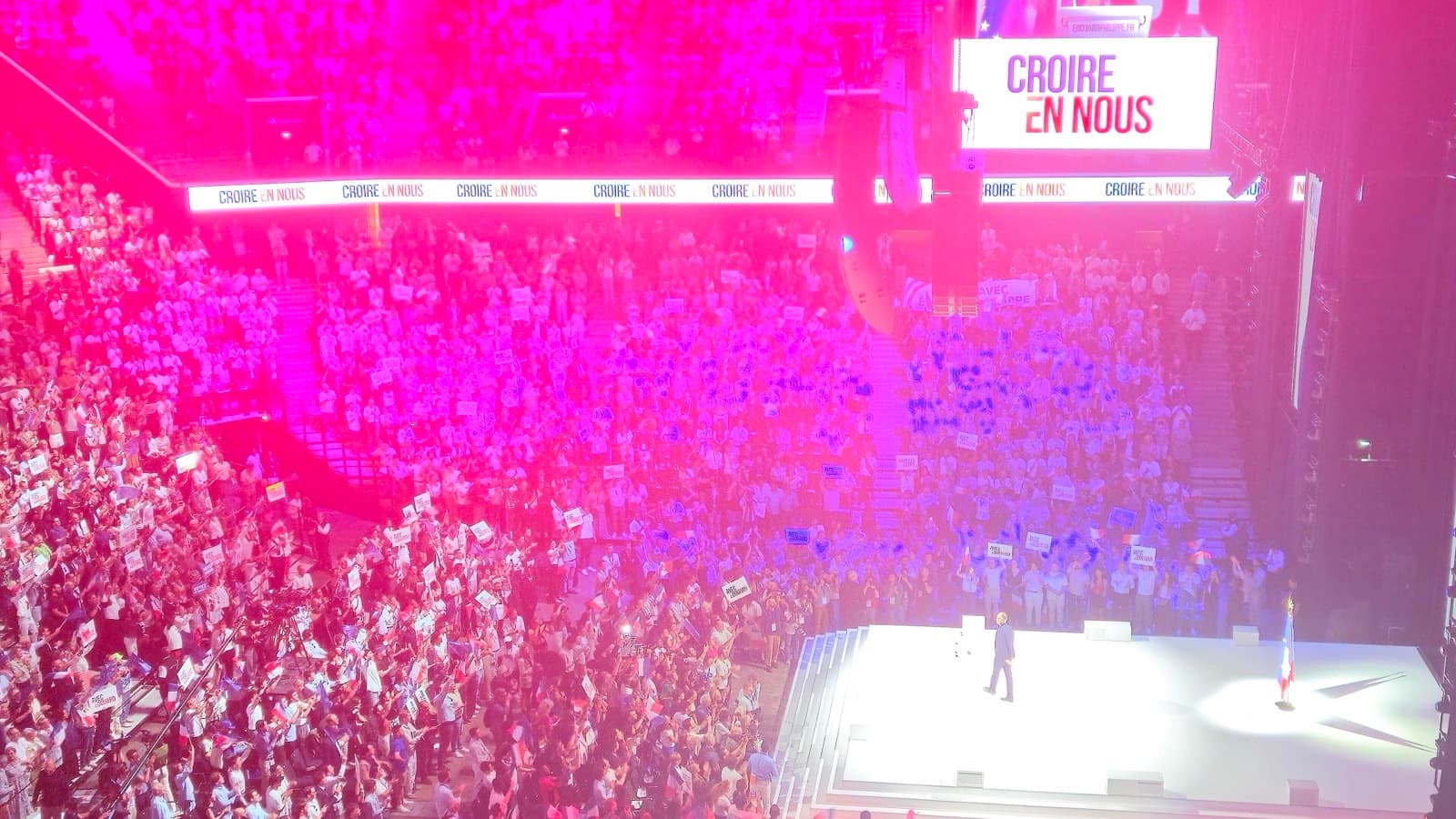
- The live eventA rally or a debate is streamed live by a channel, a platform or the candidate’s account. Campaign teams follow it with the transcript in front of them.
- Cutting on the flyPassages judged strong are cut and subtitled during the event. Agence France-Presse describes the set-up of La France insoumise, a left-wing party, which cuts and subtitles its candidate’s rallies live, then distributes the extracts to its activists and to sympathetic accounts. The MP who runs it, Antoine Léaument, calls it a “central” element of the movement’s digital communication.
- Swarm distributionOfficial accounts, activists’ accounts, anonymous clipper accounts: the same extract goes out in dozens of versions, with different subtitles and titles, on TikTok, Instagram, X and YouTube Shorts.
- The pick-upOnce an extract passes a few million views, the media pick it up and comment on it, which restarts its circulation. The daily 20 Minutes cites a sequence from a debate organised by the employers’ federation Medef in late August 2026, “seen millions of times” and picked up by the media.
Clippers: a market that appeared between two elections
In 2022, candidates reached young voters mostly from their own accounts: in March 2022, the business daily Les Échos counted 2.8 million TikTok followers for Emmanuel Macron, about one million for Jean-Luc Mélenchon and more than 250,000 for Marine Le Pen.
Between the two elections, a clipping industry took shape. In July 2026 Le Monde described a business where agencies and clippers cut long content into extracts posted en masse, noting that “music labels, film studios and political figures are taking a close interest in this discreet and inexpensive way of existing online”. In October 2026 AFP added that these agencies, often founded by people under 25, work with freelancers frequently paid per view, who post from anonymous accounts, for fees ranging from a few hundred to several tens of thousands of euros; a former MP uses one and says he has accumulated more than 1.3 million views since the summer.
The legal line is blurry, and the press says so. Article L. 52-1 of the electoral code bans, during the six months before the first day of the election month, “the use for electoral propaganda purposes of any commercial advertising process through the press or any audiovisual communication medium”: for an April 2027 election, that period has been running since October 1, 2026. Paying a provider to flood the networks with extracts could fall under that ban, 20 Minutes notes, whereas clipping done in-house by a party and its activists is allowed. To our knowledge, no court has yet ruled on a case of paid clipping.
For the market’s orders of magnitude ($1 to $5 per 1,000 views in the United States, around one euro in France), see our article on video clipping.
Where French people get their news: the numbers
The Reuters Institute’s Digital News Report 2026 puts social media at 39% as a weekly news source in France, television at 58% and print at 12%; 61% of respondents consume news video every week, and 29% say they get some of their news from content creators. Among the networks used for news: Facebook 49%, Instagram 31%, WhatsApp 31%, YouTube 29%, TikTok 17%. The 2025 edition had TikTok at 12%; year-on-year changes should be read with caution, as the questionnaire evolves.
Arcom, for its part, measures that TikTok is used every week by 26% of French people in 2026. A rally extract that travels well therefore reaches audiences who will never watch the rally.
Speaking time: what the regulator covers, and what it does not
The organic law of November 6, 1962 sets the frame: from the publication of the list of candidates until the eve of the official campaign, “audiovisual communication service editors respect, under the supervision of the Regulatory Authority for Audiovisual and Digital Communication, the principle of equity”; from the opening of the campaign until the round in which the election is decided, the principle of equality applies. These obligations cover television and radio broadcasters, not platforms.
In 2022, according to Arcom’s review, equity applied from January 1 to March 7, equity “under comparable programming conditions” from March 8 to 27, and equality from March 28 to April 22, for each round. The same report made proposals for platforms, including one to “clarify to users, and influencers in particular, the specific rules applicable during election periods”.
For 2027, Arcom has not yet published its specific rules, announced for autumn 2026. In early October its president did open a consultation with high-audience content creators who host politicians in their podcasts and videos; according to Le Monde, five of them have been contacted and recommendations could follow in early 2027. As the law stands, these formats are not audiovisual communication service editors: speaking-time obligations do not apply to them, whereas the election-eve silence of article L. 49 covers any message disseminated electronically.
The four articles of the electoral code to know
| Article | What it says | What it changes for a video extract |
|---|---|---|
| L. 49 | From midnight on the eve of the vote, a ban on “disseminating or causing to be disseminated by any means of electronic communication to the public any message of an electoral propaganda nature” | In metropolitan France, from midnight on Saturday April 17 and Saturday May 1, 2027, no more extracts with an electoral purpose |
| L. 52-1 | During the six months before the first day of the election month, a ban on using “for electoral propaganda purposes any commercial advertising process” | Since October 1, 2026: no sponsored clips and no paid advertising for a candidate; using providers paid per view is a grey area |
| L. 52-2 | No result, partial or final, may be communicated to the public before the last polling station in metropolitan France closes | On election night, no extract announcing a result or an estimate before the last polling station closes |
| L. 97 | False news, slanderous rumours or fraudulent manoeuvres that diverted votes: one year in prison and a €15,000 fine | A doctored or misleading extract relayed knowingly may fall under this article; a bill passed by the Senate on October 20, 2026 proposes to triple these penalties |
What the platforms allow
EU Regulation 2024/900 on the transparency and targeting of political advertising has applied since October 10, 2025. Rather than comply, Google announced as early as November 2024 that it would stop political advertising in the EU, YouTube included, and Meta did the same for political, electoral and social-issue ads from October 2025, while still allowing organic political content.
| Platform | Political advertising in France | AI-generated or altered content |
|---|---|---|
| TikTok | Banned by the Community Guidelines; government, politician and party accounts cannot advertise, monetise or solicit donations | Mandatory labelling of AI-generated or heavily edited content showing realistic scenes or people |
| YouTube | Stopped in the EU by Google | “Technically manipulated” election content falls under the elections misinformation policy; mandatory disclosure of realistic AI-generated or altered content |
| Instagram, Facebook | Stopped in the EU by Meta since October 2025 | “AI info” label on content detected or declared as AI-generated |
| X | Allowed in a closed list of countries that does not include France | Ban on deceptive synthetic or manipulated media, including a real person “fabricated or simulated” by AI |
Fake extracts and deepfakes: the specific risk of 2027
A truncated extract and a fabricated one are not the same problem: the first is a matter of the clipper’s ethics, the second of manipulation. Viginum, the French state agency that detects foreign digital interference, detected and characterised four foreign digital interference campaigns targeting the March 2026 municipal elections and writes that cooperation with the very large platforms “will necessarily have to be largely strengthened ahead of the 2027 presidential election”. Franceinfo reported on October 21, 2026 that the agency had already identified more than a hundred foreign disinformation operations targeting the 2027 campaign, including fake videos targeting several political figures, which Viginum attributes to pro-Russian networks.
Part of the framework already exists. The European Commission’s election guidelines under the Digital Services Act ask very large platforms to clearly label synthetic or manipulated images, audio or videos that appreciably resemble existing persons. In French law, article 226-8-1 of the penal code, created by the law of May 21, 2024, punishes with two years in prison and a €60,000 fine the non-consensual dissemination of sexual content generated by AI that reproduces a person’s image or voice, three years and €75,000 when it goes through an online service.
Before sharing a political extract, three reflexes: find the full video (the official account or the channel that streamed the event), check the date of the event, and look for an AI label from the platform. If the full source cannot be found, the extract does not get shared.
What it changes for a creator or a newsroom
Clipping is not reserved for campaign teams. A newsroom, a creator or any citizen can cut a debate to explain it, comment on it or criticise it. The conditions for an honest clip are the same as for any video, with three extra requirements:
- The complete sentence: cut after the end of the idea, never in the middle of an answer. An extract that changes the meaning of a statement is a false quote, whatever the technique.
- The source on screen and in the caption: who is speaking, where, when, and the link to the full recording.
- The calendar: no propaganda content from midnight on the eve of the vote, no results before polling stations close. In 2022, the national campaign oversight commission asked for the removal of influencer videos “that obviously amounted to electoral propaganda”: the line runs between informing and campaigning.
Frequently asked questions
When are the two rounds of the 2027 French presidential election?
Sunday April 18, 2027 for the first round and Sunday May 2, 2027 for the second, one day earlier in several overseas territories. The official list of candidates is published by March 26, 2027, after endorsements close on March 12.
Is a creator or a podcast subject to the regulator’s speaking-time rules?
No. The equity and equality rules apply to television and radio broadcasters. Arcom opened a consultation with the most-followed creators in October 2026 and may publish recommendations in early 2027, but the election-eve silence applies to everyone.
Can you publish a debate extract on the Saturday before the vote?
From midnight on the eve of the vote, article L. 49 of the electoral code bans the electronic dissemination of any message of an electoral propaganda nature. In 2022 the campaign oversight commission had influencer videos that obviously amounted to propaganda taken down. The cautious approach is to publish nothing that calls for a vote for or against anyone that day.
Is political advertising possible on TikTok, YouTube, Instagram or X in France?
No. Google and Meta stopped political advertising in the European Union with the EU regulation applicable since October 10, 2025, TikTok bans it in its rules, and X only offers it in a list of countries that does not include France. The French electoral code bans commercial advertising for electoral purposes during the six months before the vote in any case.
How do you check that a political extract is not doctored?
Find the full video on the official account or the channel that streamed the event, check the date of the event, look for an AI label from the platform and compare the passage with the full recording. Viginum has already identified more than a hundred foreign disinformation operations targeting the 2027 campaign: an extract without a full source does not get shared.
Cover photo: Rémi Noyon, CC BY 2.0, Wikimedia Commons.